

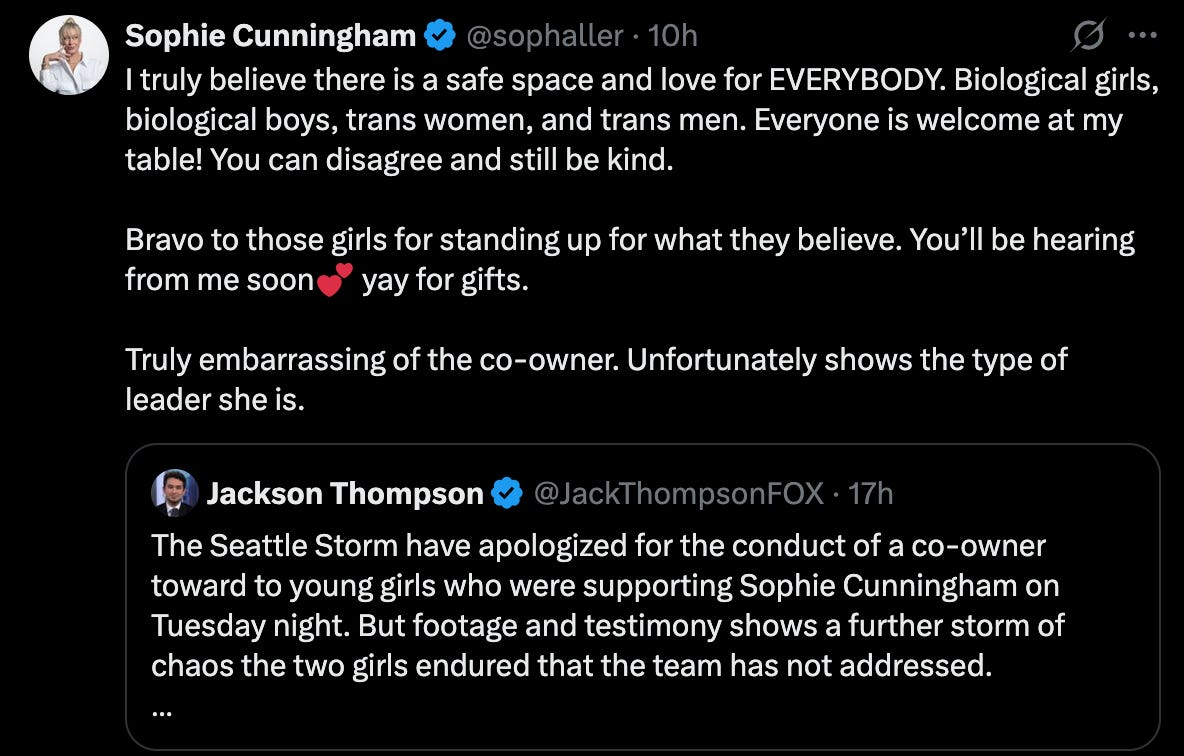
Sophie Cunningham and Kyle Kuzma went viral this week for two equally absurd takes.
I was on holiday when I saw it. The finger-pointing guard wasn’t a girls’ girl.
”I want to protect young girls in a locker room, or young girls in sport who shouldn’t have to go against biological men. I think it’s common sense...it’s really important to protect children, and little girls who are also involved in that category.”
A day later, the NBA upped the ante. Mister anti-defence put in a career best on Zohran Mamdani - New York’s Batman - for suggesting Israeli Prime Minister Benjamin Netanyahu should face arrest.
The conversations that followed missed the point entirely. People were either debating whether Cunningham and Kuzma needed better media training or defending their right to express opinions.
Here’s the thing, though: basketball has never been apolitical.
Craig Hodges wore a dashiki to the White House after winning the title and delivered a handwritten letter to President George H.W. Bush condemning the administration’s treatment of poor and minority communities.
Bill Russell marched for civil rights, stood alongside Muhammad Ali in support of his refusal to fight in the Vietnam War, and used his status to challenge systemic racism in America.
Maya Moore fought against the mass imprisonment of black men, including helping to reveal the wrongful conviction of Jonathan Irons.
Following the police shooting of Jacob Blake, the Milwaukee Bucks refused to take the court, triggering a multi-day strike that brought the play-offs to a standstill.
None of those decisions came without consequence. Russell was ostracised. Hodges was effectively blackballed. Enes Kanter’s criticism of the Chinese government’s treatment of Uyghur Muslims froze him out of free agency.
Nowadays, you can say whatever you want without very little institutional pushback.
Under the WNBPA policy, players are treated as “thoughtful adults with their own perspectives.” But adulthood comes with accountability. If you eat all your cake, then the change in the scale shouldn’t be a surprise.
Make morality part of your public identity, and people are entitled to examine whether your principles are applied consistently. That’s where Cunningham’s argument begins to unravel.
ESPN’s Hallie Grossman described the family as people who were never “inclined to sand down their rough edges.” Her sister proudly said they wouldn’t “take shit from no one.”
Fair enough.
So where was that same conviction when Cunningham posed alongside UFC president Dana White at an event headlined by Conor McGregor? If protecting women is genuinely the guiding principle, why is the loudest public intervention reserved for transgender athletes - mind you, we’ve only seen one in WNBA history - while allegations of violence against women or sexual harassment receive no comparable urgency?
Where was the uproar when former teammate Brianna Turner alleged that last season a male staff member was fired for sexual harassment, and players were encouraged to keep quiet?
A 2025 study on workplace harassment in the US conducted by Traliant revealed that:
Nearly four in ten employees (38%) report witnessing workplace harassment in the past five years, and 21% have been directly targeted. The situation is more pronounced among Gen Z employees, with nearly half (46%) witnessing harassment and one-third (33%) experiencing it firsthand.
Cunningham is 29 - born in 1996. She narrowly misses the cut-off, but still fits the bill.
Whether she should’ve commented isn’t the point. Inconsistency is.
If you single out an already marginalised group but say nothing about the impact of domestic violence toward the same demographic, the rest of us get the impression that you’re selective about your moral outrage.
Of course, as of writing, the Indiana Fever have not made her available for press conferences. They claimed to be “unaware” that her comments had resulted in an anti-trans gathering before the Seattle Storm game. One that spilt over court-side when Storm co-owner Celeste Keaton got into a verbal altercation with two fans who brought in supportive signs.
The result? Keaton was banned from attending the team’s next five home games and fined an undisclosed amount.
Cunningham’s response was to back track because I’m sure somewhere down the line, it’ll be more favourable for her to be vague about whether she’s on one side of the fence or the other. What she perceives as censorship is scrutiny.
The same contradiction applies to Kuzma, who’s probably replying to a bot on Twitter after he got slam-dunked by Wemby Central:
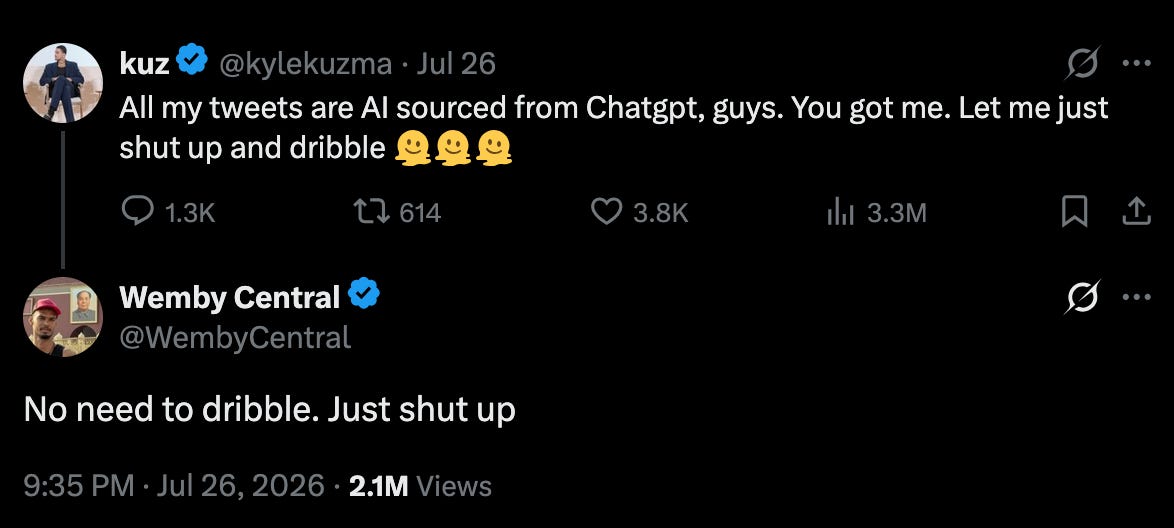
When Drew Brees criticised Colin Kaepernick’s protest against racial injustice, Kuzma was quick to respond, accusing companies and public figures of supporting causes only when it was convenient.
He was right.
Following Breonna Taylor’s killing, he demanded accountability and criticised the systemic stereotypes imposed on Black Americans.
Again, he was right.
So when he dismissed Mamdani as one of the “people cosplaying as things they don’t have the authority, the talent, or the track record to actually be,” the obvious question wasn’t whether he had the right to say it, but why the same moral framework wasn’t being applied.
If he is capable of being a staunch protester against discrimination, then how is it that the same mindset isn’t being applied to the occupants of Gaza? Or even those who are trying to advocate for them like Mamdani? Once you’re swimming in the ocean, it’s up to you to fend off the sharks.
Consistency doesn’t mean commenting on every war, election or injustice. It means applying the same moral standard regardless of whether the issue is politically convenient, personally popular or likely to attract applause.
The damning question is this: if you’re going to build a public identity around morality, are you prepared for people to measure the constancy?
Readers rarely miss a beat. They are entitled to ask the hard questions, and unfortunately, if your answer is something along the lines of “I said what I said”, then was the cause ever the point?
If politics is just “cosplay”, the costume eventually slips. We’re just watching the act fall apart.
Every now and then, I write pieces like this because, as a brown woman, it's important for me to advocate against hateful rhetoric. I hope it is received with as much love as I intend it to give.